What a singing bowl actually does
One study, sixty-two people, and a result worth taking seriously, as long as you also take seriously what it cannot tell you.
We sell attention here, not magic. So it seems fair to show you the actual evidence for the most mystical-looking object in the shop.
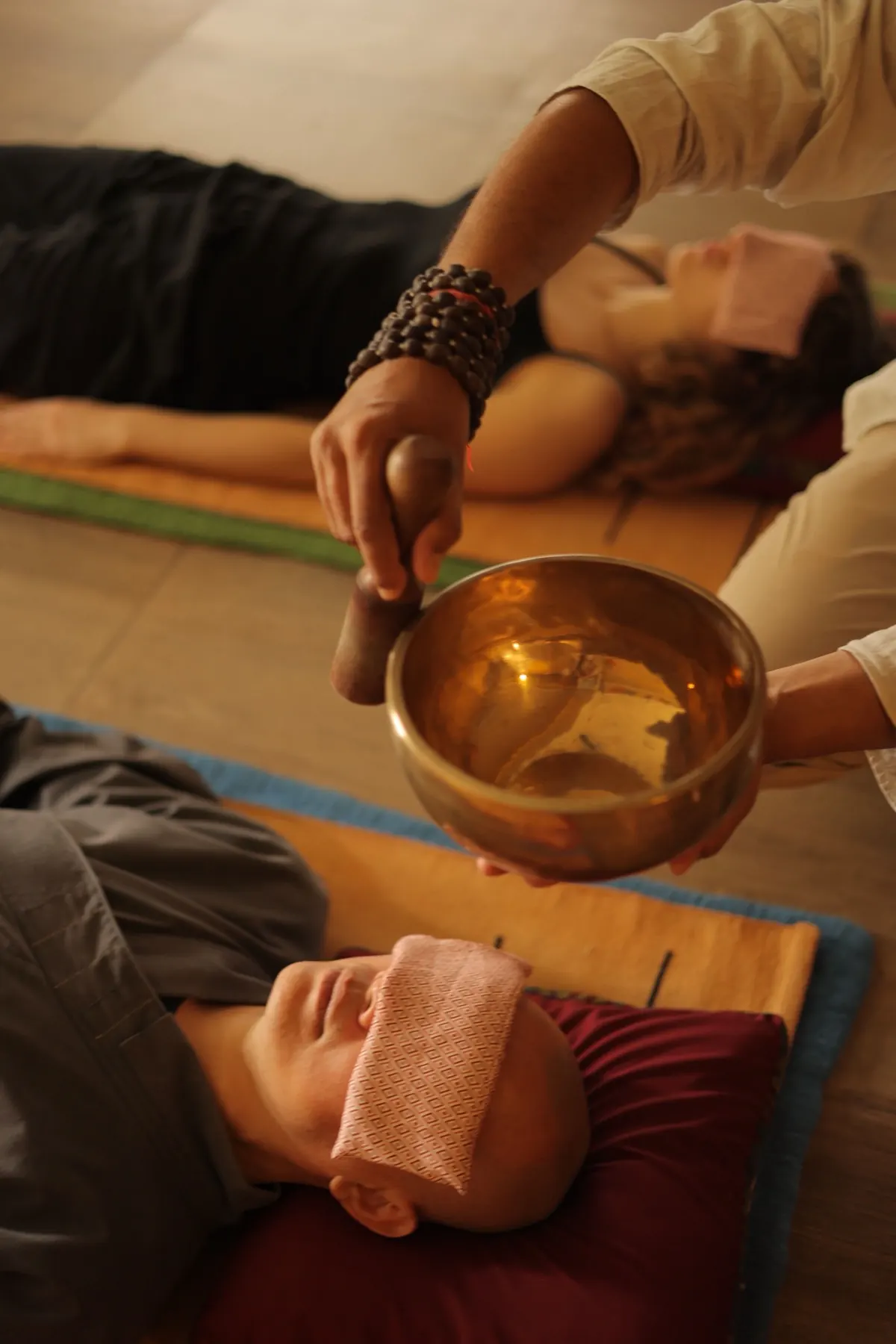
The most-cited study is Goldsby and colleagues, published in 2017 in the Journal of Evidence-Based Complementary & Alternative Medicine. Sixty-two adults, average age just under fifty, attended a single singing-bowl sound meditation. They completed standard mood questionnaires immediately before and immediately after.
The results were not subtle. Tension, anger, fatigue and depressed mood all fell significantly, all p < .001, with large effect sizes across the mood subscales. Two details stand out. The biggest drop in tension came in the youngest group, the twenty-to-thirty-nine-year-olds, whose mean tension score fell from 1.6 to 0.2. And people who had never done this kind of meditation before improved more than the experienced ones.
Now the part that gets left out
This was an observational study. There was no control group. Nobody was randomised. Nobody was blinded. You cannot blind a person to whether a room is full of ringing quartz.
Which means the study genuinely cannot separate the bowls from everything that came with them: an hour lying on the floor, in a quiet room, with no phone, among people who had chosen to be there.
The tension dropped. The study cannot tell us whether the bowls did it.
That is not a takedown. Pre-post studies are how a field starts, and a large effect in a real setting is a reasonable thing to build on. A more recent systematic review of clinical singing-bowl studies reaches roughly the position you would expect: promising signals, small studies, weak designs.
So why is it still in the shop
Because the honest claim is enough.
The honest claim is not that 432 Hz retunes your cells. It is that a long, decaying tone gives attention something simple to rest on, and that a practice you actually keep beats a better practice you abandon. Some people cannot sit with silence and can sit with a sound. If that is you, this is a good object.
And if it is not you, buy nothing. Come to the Monday Service instead. It costs nothing, and the hour is the active ingredient in both.