The plant that worked, until more people looked
In 2019 the pooled trials said peppermint oil helps three people in every four you treat. In 2022 the same question was asked again, and the answer got smaller and less certain.
This is the most convincing herbal result we have found, and it is also the clearest example of why one meta-analysis is not an answer. Two of them, three years apart, asked the same question about the same plant. The later one is less sure.
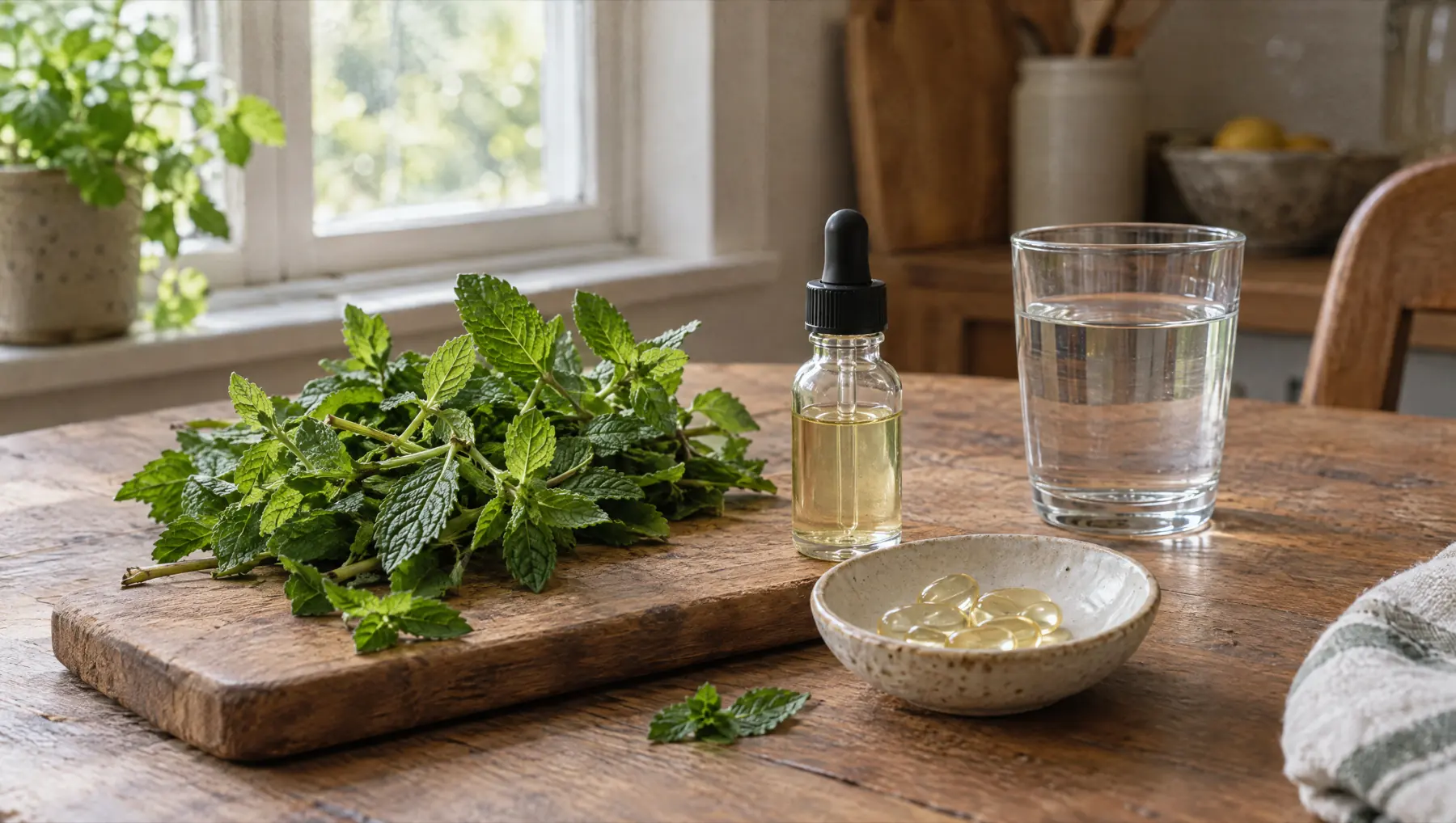
Enteric-coated peppermint oil is used for irritable bowel syndrome. The coating matters: it is what carries the oil past the stomach so it reaches the gut, where it relaxes smooth muscle. This is not folklore with a modern label on it. It is a plant extract that has been through more randomised trials than almost anything else on this site.
What the 2019 pooling found
Alammar and colleagues pooled twelve randomised trials and 835 patients in BMC Complementary and Alternative Medicine. The numbers were large:
- For global IBS symptoms, across seven trials and 507 people, the risk ratio was 2.39 (95% CI 1.93 to 2.97). The number needed to treat was three.
- For abdominal pain, across six trials and 556 people, the risk ratio was 1.78 (95% CI 1.43 to 2.20). The number needed to treat was four.
- Adverse events were 9.3% on peppermint oil against 6.1% on placebo, which was not a statistically significant difference. Heartburn was the most common, and the authors described most events as mild and transient.
A number needed to treat of three is a good number. It means that for every three people given the capsule rather than placebo, one more got better than would have anyway.
What the authors said about their own trials
The same paper is careful about its material. Six of the twelve trials were at high risk of attrition bias, because more than one person in ten dropped out and was not accounted for. Random sequence generation and allocation concealment were frequently not reported at all, which means nobody outside those studies can check whether the randomisation was real.
Then two larger trials came back negative
In 2022, Ingrosso, Ianiro, Nee, Lembo, Moayyedi, Black and Ford asked the question again in Alimentary Pharmacology and Therapeutics, with the literature searched to April of that year. They found ten eligible trials and 1030 patients, more people than the 2019 review had, and the picture changed:
- Peppermint oil still beat placebo for global symptoms, at a number needed to treat of four rather than three.
- For abdominal pain the number needed to treat was seven.
- Adverse events were now significantly more common on peppermint oil than on placebo, at a risk ratio of 1.57 (95% CI 1.04 to 2.37).
- The authors graded the quality of the evidence as very low, and wrote that recent studies have cast doubt on its role in treating IBS.
Nothing was retracted and nobody was caught out. Two larger and more recent trials simply did not find what the earlier, smaller ones had, and when they were added to the pool the effect shrank and the uncertainty around it widened.
What we do with this
We keep it, and we describe it accurately. Peppermint oil remains one of very few plant preparations with repeated randomised evidence behind it, and it is cheap, and the harm is heartburn rather than anything serious. That is a reasonable thing to try for a fortnight if your gut is the problem.
What it is not is settled. The people who ran the most recent and most careful pooling of it asked for adequately powered trials, which is the polite way of saying that the trials so far have been too small to answer the question properly. If somebody sells you this as proven, they have read the 2019 paper and stopped.